Mitigate workplace traffic risks in real time
Vehicle controls detection is computer vision that watches forklifts and other industrial vehicles around people and each other — proximity, wrong-way driving and zone breaches — and alerts before an interaction becomes a collision.
Vehicle controls detection covers 5 real-time computer-vision use cases in the Intenseye detection & use case library — Designated vehicle zone, Vehicle restricted zone, Vehicle-pedestrian proximity, Vehicle-vehicle proximity and Wrong-way driving — on the cameras you already have or on Sentinel devices.
Vehicle interactions are a major cause of serious injuries and disruptions. Intenseye’s Vehicle Controls detects high-risk activity the moment it happens—preventing collisions, and improving traffic flow across your sites.
- Prevent collisions and near-misses
- Reduce SIF exposure from high-risk interactions
- Optimize traffic flow with real-time insights
AI-powered vehicle controls
Pre-trained AI models recognize the most widely used vehicles across industries to ensure safer traffic flows.
Forklift and pedestrian interactions are among the most serious risks on an industrial floor, and the usual controls — floor markings, designated routes, direction rules — are hard to verify beyond the occasional audit or near-miss report. Vehicle controls detection watches those rules continuously, on the same cameras that already cover your aisles and yards.
Intenseye's pre-trained models recognize forklifts and the other vehicles most widely used across industries, then apply your rules to them: how close a vehicle may come to a pedestrian or another vehicle, which zones are vehicle-only or vehicle-free, which direction traffic flows. A breach raises a real-time alert, and every event is logged so traffic flow can be redesigned where near-misses cluster.
5 use cases in this category
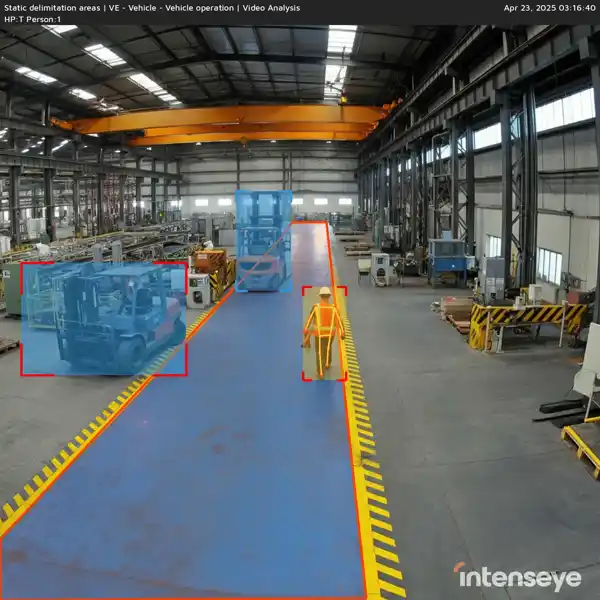
Designated vehicle zone
Confirms vehicles operate only within their approved zones.
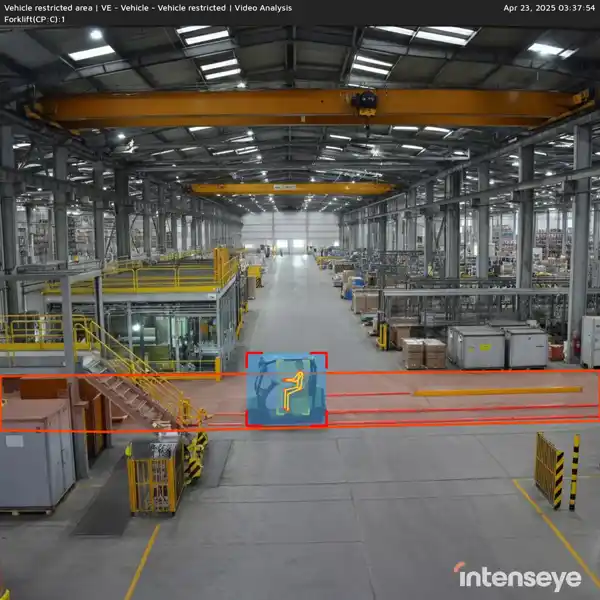
Vehicle restricted zone
Flags a vehicle entering an area where vehicles are not permitted.
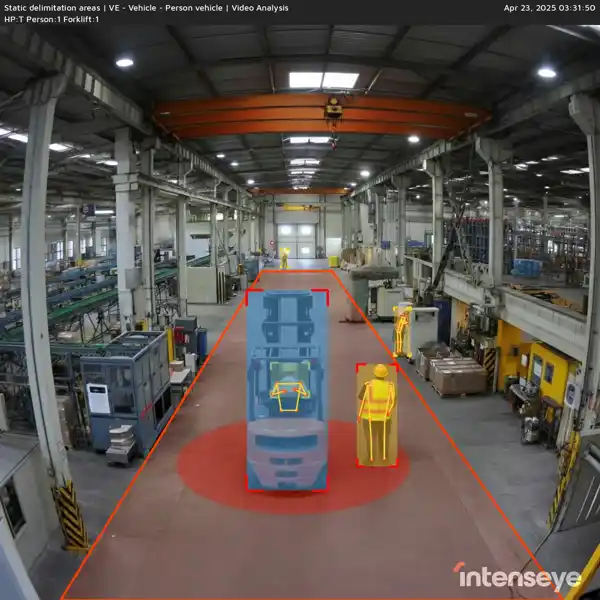
Vehicle-pedestrian proximity
Detects a moving vehicle coming close enough to a worker on foot to risk a struck-by incident.
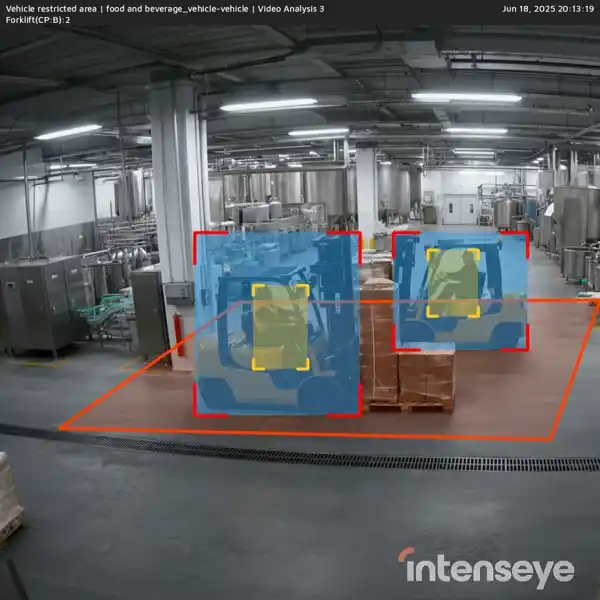
Vehicle-vehicle proximity
Detects vehicles closing to an unsafe distance from one another.
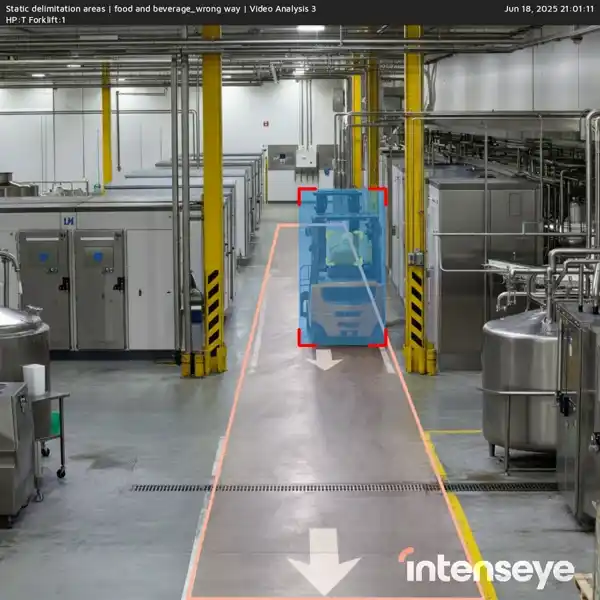
Wrong-way driving
Detects a vehicle traveling against the designated flow direction.
Why it matters to EHS leaders
AI-powered road safety
Leverage real-time insights to monitor vehicle and pedestrian safety, ensuring immediate action when needed.
Drive operational efficiency
Enhance coordination across vehicle movements and minimize disruptions, improving overall site productivity.
Tailored for your worksite
Our AI models are trained on your specific work zones—securely developed in-house with no external data sharing.
Vehicle Controls detections across industries
The first three industries are open below; expand another to read how each use case applies on that floor — the same per-industry context the full library shows when you filter by industry.
Industrial Manufacturing5 use cases
- Designated vehicle zone
- Restricts vehicles to approved zones, separating them from pedestrian workspaces.
- Vehicle restricted zone
- Prevents unauthorized vehicles from entering zones with hazardous or foot-traffic-heavy layouts.
- Vehicle-pedestrian proximity
- ↔️🚛 Monitors proximity to avoid collisions in mixed pedestrian-vehicle areas.
- Vehicle-vehicle proximity
- ↔️🚚 Prevents close contact or collisions between material-handling vehicles.
- Wrong-way driving
- Detects wrong-way vehicle traffic that increases risk of head-on or blind-corner collisions.
Food and Beverage5 use cases
- Designated vehicle zone
- Prevents tuggers or pallet jacks from entering food processing or clean zones during operation.
- Vehicle restricted zone
- Prevents unauthorized vehicles from entering high-risk or contamination-sensitive areas.
- Vehicle-pedestrian proximity
- ↔️🚛 Detects proximity issues between vehicles and pedestrians in bottling and palletizing areas.
- Vehicle-vehicle proximity
- ↔️🚚 Prevents collisions between carts, lifts, and tuggers in narrow cold or production aisles.
- Wrong-way driving
- Detects reverse or wrong-direction travel of carts or vehicles that may cause head-on collisions.
Automotive5 use cases
- Designated vehicle zone
- Keeps test vehicles and forklifts confined to safe zones, away from foot traffic.
- Vehicle restricted zone
- Restricts powered industrial trucks from entering assembly or inspection lines unintentionally.
- Vehicle-pedestrian proximity
- ↔️🚛 Prevents accidents between forklifts and workers during material drops or line-side delivery.
- Vehicle-vehicle proximity
- ↔️🚚 Detects risky interactions between AGVs, forklifts, and transport tuggers in shared lanes.
- Wrong-way driving
- Detects wrong-way travel in one-way aisles to prevent blind-corner accidents.
Industrial Machinery5 use cases
- Designated vehicle zone
- Restricts vehicles to approved zones, separating them from pedestrian workspaces.
- Vehicle restricted zone
- Prevents unauthorized vehicles from entering zones with hazardous or foot-traffic-heavy layouts.
- Vehicle-pedestrian proximity
- ↔️🚛 Monitors proximity to avoid collisions in mixed pedestrian-vehicle areas.
- Vehicle-vehicle proximity
- ↔️🚚 Prevents close contact or collisions between material-handling vehicles.
- Wrong-way driving
- Detects wrong-way vehicle traffic that increases risk of head-on or blind-corner collisions.
Chemicals5 use cases
- Designated vehicle zone
- Keeps forklifts and tankers within defined movement zones, separating them from pedestrian and mixing activities.
- Vehicle restricted zone
- Prevents unauthorized vehicle access to chemical transfer, mixing, or hazard containment zones.
- Vehicle-pedestrian proximity
- ↔️🚛 Monitors separation between mobile equipment and foot traffic in narrow chemical plant corridors.
- Vehicle-vehicle proximity
- ↔️🚚 Detects proximity between chemical tankers or forklifts moving in tight processing areas to prevent contact or tipping.
- Wrong-way driving
- Prevents vehicles from traveling in reverse or wrong directions around chemical delivery bays and loading docks to reduce collision risk.
Warehouses5 use cases
- Designated vehicle zone
- Keeps powered industrial trucks within safe paths, separating them from walking workers and storage areas.
- Vehicle restricted zone
- Blocks unauthorized vehicle entry into zones like pick modules, packaging lines, or restock staging areas.
- Vehicle-pedestrian proximity
- ↔️🚛 Detects close encounters between forklifts and employees in shared spaces to reduce struck-by incidents.
- Vehicle-vehicle proximity
- ↔️🚚 Prevents collisions between forklifts or tuggers in congested loading zones or narrow aisles.
- Wrong-way driving
- Prevents reverse or wrong-way driving in one-way warehouse lanes, reducing risk of blind corner accidents.
Metals & Steel5 use cases
- Designated vehicle zone
- Ensures haulers and loaders stay within defined paths during molten or heavy load movement.
- Vehicle restricted zone
- Prevents unauthorized vehicles from entering forging, rolling, or scrap containment areas.
- Vehicle-pedestrian proximity
- ↔️🚛 Monitors proximity in shared spaces like coil delivery or furnace loading to avoid contact.
- Vehicle-vehicle proximity
- ↔️🚚 Prevents collisions between cranes, scrap haulers, or coil trucks in blind intersections.
- Wrong-way driving
- Detects vehicles traveling against flow in coil yards or press loading bays, reducing risk of collision.
Building Materials5 use cases
- Designated vehicle zone
- Confirms safe vehicle operation in haul paths, inside mix halls, or by silo access roads.
- Vehicle restricted zone
- Prevents unauthorized vehicle access to curing lines, mold setups, or press platform zones.
- Vehicle-pedestrian proximity
- ↔️🚛 Detects collision risks between moving forklifts or tuggers and ground workers in busy storage areas.
- Vehicle-vehicle proximity
- ↔️🚚 Identifies trailer-to-hauler or forklift-to-dump-truck conflict points at yards and load stations.
- Wrong-way driving
- Detects vehicles moving against flow in shared load zones or concrete pour bays to prevent head-on risks.
Containers Packaging and Paper5 use cases
- Designated vehicle zone
- Ensures mobile equipment stays in designated transport paths around presses, trimmers, and bundlers.
- Vehicle restricted zone
- Prevents mobile equipment from entering fragile or high-speed packaging and inspection zones.
- Vehicle-pedestrian proximity
- ↔️🚛 Prevents contact between foot traffic and forklifts or roll pushers near staging or loading areas.
- Vehicle-vehicle proximity
- ↔️🚚 Detects forklift or tugger collision risks in intersecting paths near corrugator bays or roll queues.
- Wrong-way driving
- Detects equipment or cart movement in the wrong direction in narrow paper roll or packaging lanes.
Air Cargo, Logistics & Transportation5 use cases
- Designated vehicle zone
- Keeps vehicles in designated paths around airside load zones, ramps, and bonded cargo bays.
- Vehicle restricted zone
- Prevents vehicle intrusion into customs inspection zones, jet bridge areas, or fragile cargo sorting lanes.
- Vehicle-pedestrian proximity
- ↔️🚛 Alerts when personnel and ground vehicles come too close in shared sortation or ramp areas.
- Vehicle-vehicle proximity
- ↔️🚚 Detects tight spacing and collision risk between vehicles in loading queues or airside handoff points.
- Wrong-way driving
- Detects wrong-way movement by service vehicles or carts in loop-based logistic routes.
Vehicle Controls in action
Runs on the CCTV you already own. No rip-and-replace. Add Sentinel devices only where a normal camera can't see - low light, heat, depth, or outdoor.
Detect
Tailor AI models to identify unsafe traffic behaviors instantly, from speed violations to near-miss incidents.
Act
Alert safety teams in real time to prevent collisions and enforce traffic safety rules.
Protect
Continuously monitor and refine traffic controls to reduce vehicle-related risks.
Related terms
PVI (Pedestrian-Vehicle Interaction)
A moment where a worker on foot and a moving vehicle - forklift, truck, AGV - come close enough to risk a struck-by incident. Intenseye detects PVI events to surface high-conflict zones before a collision happens.
Struck-by / caught-in
Two of the most common serious-injury mechanisms: struck-by is contact by a moving object or vehicle; caught-in is being pinned, crushed, or drawn into machinery. Both are core targets for real-time detection.
Near-miss
An unplanned event that did not result in injury or damage but easily could have. Near-misses are leading signals - catching them is a chance to fix a hazard before it causes harm.
Congestion
Crowding of people or vehicles in a shared space at the same time. Congestion signals both a safety risk (more interaction points) and an operational drag (flow slows down).
Hard Stop
An emergency safety intervention triggered when the system detects a pSIF-level event during non-routine work. Hard Stop can halt equipment or processes automatically to prevent a serious injury or fatality.
Alert
A notification generated when a system detects a defined condition, such as a worker entering a restricted zone or missing required equipment.
What is the best way to ensure forklift and pedestrian safety?
The most effective approach to ensuring forklift and pedestrian safety is through AI-powered safety management software. By integrating advanced algorithms and real-time data analysis capabilities, this software can continuously analyze the movements of forklifts and pedestrians within the workplace.
Intenseye can detect forklift-pedestrian safety risks at workplaces by employing computer vision technology to continuously analyze the environment. By analyzing live video feeds from cameras installed across the facility, Intenseye can identify potential hazards such as forklifts operating in pedestrian-heavy areas or instances of pedestrians straying into designated forklift zones.
Through its sophisticated algorithms, Intenseye can detect unsafe conditions in real-time, such as near-misses or risky behavior patterns, and promptly notify the Environmental Health and Safety (EHS) teams. This enables swift intervention and corrective actions to be taken, minimizing the risk of accidents and ensuring the safety of both forklift operators and pedestrians in the workplace.
How to improve forklift pedestrian safety
Improving forklift pedestrian safety involves a robust approach, and leveraging advanced technology like Intenseye's AI-powered safety management software can be a game-changer. Intenseye's innovative "dynamic delimitation" feature utilizes computer vision to detect interactions between forklifts and pedestrians within a specified proximity. This real-time data not only alerts EHS teams to potential near misses but also aids in the creation of comprehensive forklift/pedestrian maps, distinguishing risky areas from safe zones.
Intenseye goes beyond mere alerts by providing detailed insights through its heat map feature. This visual representation allows users to pinpoint areas of concern within their facilities, facilitating unbiased evaluation of current safety controls. Armed with this knowledge, site teams can continuously audit and enhance safety measures, ensuring a proactive approach to risk mitigation.
Moreover, Intenseye's ability to collect and trend a vast amount of data enables companies to gain a deeper understanding of their risk profile. By integrating with various communication channels like SMS, email, or smart speakers, Intenseye ensures that EHS teams are promptly notified of unsafe behaviors, fostering a culture of safety in the workplace.
Incorporating AI-powered safety management software like Intenseye into safety programs not only enhances forklift and pedestrian safety but also streamlines operations and minimizes risks.
What is a pedestrian safety zone?
A pedestrian safety zone is an area within a facility designated to prioritize the safety of individuals on foot, typically separated from vehicle traffic or high-risk areas. It aims to reduce the risk of accidents involving pedestrians and vehicles by implementing specific safety measures and controls.
Intenseye’s AI-powered safety management software ensures pedestrian safety within facilities uniquely through its advanced AI-powered safety management software. By employing computer vision technology, Intenseye dynamically delimits pedestrian safety zones, identifying and analyzing interactions between pedestrians and vehicles in real-time. This innovative approach goes beyond static demarcations, allowing for adaptable safety measures that respond to dynamic environments and changing conditions.
How to detect forklift speed limit
Detecting forklift speed limits in the workplace can be achieved through various methods such as using speed limit signs or markings, installing speed monitoring devices or GPS trackers on forklifts, implementing training programs to educate operators on safe speeds, and conducting regular inspections to ensure compliance. These measures are crucial for preventing accidents and ensuring the safety of both operators and other workers in the vicinity of forklift operations.
Intenseye's AI-powered safety management software offers a sophisticated solution to enhance forklift safety. With its real-time monitoring capabilities, the software can track forklift movement and promptly detect instances of speeding. By sending alerts to supervisors or operators when speed limits are exceeded, Intenseye enables immediate intervention to prevent accidents.
Explore the other categories
See the use cases in action on your floor
Reduce your safety risk today.