Automate ergonomic assessments with AI
Ergonomic risk detection is computer vision that scores working postures with REBA and RULA — continuously, on the cameras you already have — to find the strain that becomes a musculoskeletal disorder.
Ergonomic risk detection covers 2 real-time computer-vision use cases in the Intenseye detection & use case library — Full-Body Ergonomic Risk Assessment (REBA) and Upper Body Ergonomic Risk Assessment (RULA) — on the cameras you already have or on Sentinel devices.
Strain, poor posture, and repetitive motion are key drivers of workplace injuries and rising claims. Intenseye’s Ergonomics detects these risks in real time—reducing MSDs, cutting costs, and improving productivity.
- Reduce MSDs with real-time risk detection
- Automate RULA & REBA across your sites
- Protect productivity with faster intervention
AI-powered ergonomic risk detection
Pre-trained AI models built on millions of human motion data points and industry-proven ergonomic assessment methodologies like RULA(Rapid Upper Limb Assessment) and REBA(Rapid Entire Body Assessment).
Ergonomic risk is cumulative: a bent back, a raised arm or a repeated lift rarely injures on the first occurrence, but repeated across a shift and a year it becomes a musculoskeletal disorder. Traditional assessments capture a moment; ergonomic risk detection scores the posture every time it occurs, across the whole shift.
Intenseye uses body pose estimation on your existing cameras to analyze posture, load and repetition in real time, scoring full-body risk with REBA and upper-body risk with RULA — no wearables, no observation backlog. Risks above safe limits raise alerts and corrective tasks, and the scores are tracked over time so you can see whether a change on the floor actually reduced exposure.
2 use cases in this category
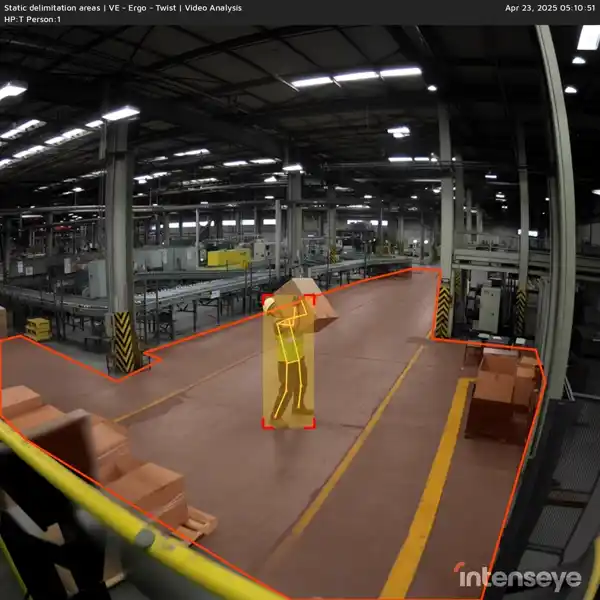
Full-Body Ergonomic Risk Assessment (REBA)
Identifies ergonomic risk in repetitive tasks like slicing, packaging, and ingredient handling to prevent back and shoulder strain.
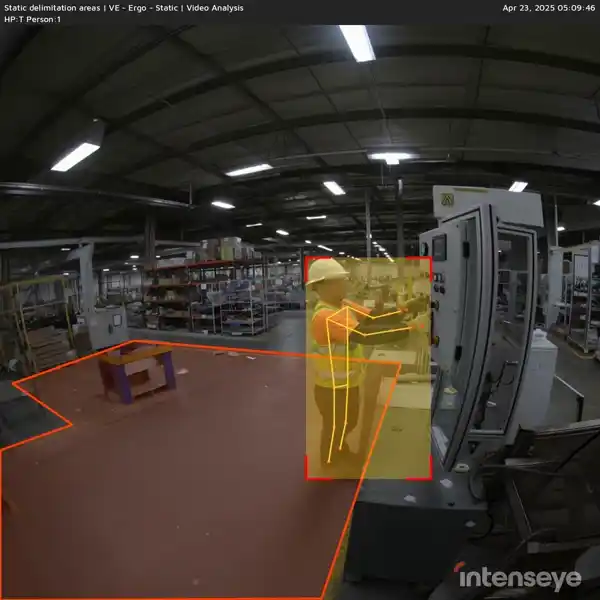
Upper Body Ergonomic Risk Assessment (RULA)
Evaluates posture during overhead reach, assembly, or sorting to reduce repetitive motion injuries in prep lines.
Why it matters to EHS leaders
AI-driven REBA & RULA assessments
Automates full-body (REBA) and upper-limb (RULA) evaluations, using real-time posture, load, and movement analysis to quantify ergonomic risks and prevent injuries with data-backed insights.
Proactive risk detection
Continuously tracks workplace movements, assessing weight, grip difficulty, and task frequency to provide instant alerts when ergonomic risks exceed safe limits.
Scalable, facility-wide insights
Customizable AI-driven assessments ensure consistent risk evaluation across all work areas, enabling targeted interventions to reduce musculoskeletal injuries and enhance workplace safety.
Ergonomics detections across industries
The first three industries are open below; expand another to read how each use case applies on that floor — the same per-industry context the full library shows when you filter by industry.
Industrial Manufacturing2 use cases
- Full-Body Ergonomic Risk Assessment (REBA)
- Analyzes posture and movement patterns to reduce long-term musculoskeletal disorders from repetitive full-body tasks.
- Upper Body Ergonomic Risk Assessment (RULA)
- Evaluates upper-body posture risks like neck or shoulder strain in seated or reach-intensive tasks.
Food and Beverage2 use cases
- Full-Body Ergonomic Risk Assessment (REBA)
- Identifies ergonomic risk in repetitive tasks like slicing, packaging, and ingredient handling to prevent back and shoulder strain.
- Upper Body Ergonomic Risk Assessment (RULA)
- Evaluates posture during overhead reach, assembly, or sorting to reduce repetitive motion injuries in prep lines.
Automotive2 use cases
- Full-Body Ergonomic Risk Assessment (REBA)
- Flags poor posture during repetitive part lifting, tire assembly, or cable installation to prevent chronic strain.
- Upper Body Ergonomic Risk Assessment (RULA)
- Detects arm, wrist, and shoulder strain during wiring, seat installation, or overhead work under hoods.
Industrial Machinery2 use cases
- Full-Body Ergonomic Risk Assessment (REBA)
- Analyzes posture and movement patterns to reduce long-term musculoskeletal disorders from repetitive full-body tasks.
- Upper Body Ergonomic Risk Assessment (RULA)
- Evaluates upper-body posture risks like neck or shoulder strain in seated or reach-intensive tasks.
Chemicals2 use cases
- Full-Body Ergonomic Risk Assessment (REBA)
- Evaluates ergonomic risk from frequent container lifting, hose dragging, or awkward valve access in chemical production lines.
- Upper Body Ergonomic Risk Assessment (RULA)
- Detects repetitive upper-body strain during sampling, pouring, or manual labeling tasks in chemical batch operations.
Warehouses2 use cases
- Full-Body Ergonomic Risk Assessment (REBA)
- Identifies poor full-body ergonomics during repetitive lifting, stacking, or bending in order picking zones.
- Upper Body Ergonomic Risk Assessment (RULA)
- Monitors upper-body strain during shelf stocking, scanning, and labeling tasks that require awkward reach or force.
Metals & Steel2 use cases
- Full-Body Ergonomic Risk Assessment (REBA)
- Highlights posture risks during repeated handling of heavy tools, billets, or scrap sorting.
- Upper Body Ergonomic Risk Assessment (RULA)
- Detects repetitive strain from pressing, grinding, or tool loading activities targeting upper-body fatigue.
Building Materials2 use cases
- Full-Body Ergonomic Risk Assessment (REBA)
- Flags improper lifting and posture while loading forms, shoveling material, or maneuvering product molds.
- Upper Body Ergonomic Risk Assessment (RULA)
- Detects shoulder and upper limb strain during repetitive troweling, block placement, or tile trimming work.
Containers Packaging and Paper2 use cases
- Full-Body Ergonomic Risk Assessment (REBA)
- Evaluates ergonomic strain from repetitive stacking, lifting, or manual label application in production cells.
- Upper Body Ergonomic Risk Assessment (RULA)
- Identifies upper-body repetitive motion during carton folding, gluing, and reel threading tasks.
Air Cargo, Logistics & Transportation2 use cases
- Full-Body Ergonomic Risk Assessment (REBA)
- Evaluates poor posture during frequent cargo loading, pushing ULDs, or restocking freight belts.
- Upper Body Ergonomic Risk Assessment (RULA)
- Detects repetitive upper-body motion during labelling, scanning, or container sealing tasks.
Ergonomics in action
Runs on the CCTV you already own. No rip-and-replace. Add Sentinel devices only where a normal camera can't see - low light, heat, depth, or outdoor.
Detect
Leverage AI-powered body pose estimation to analyze postures, repetitive movements, and high-risk actions in real time.
Act
Automatically identify risks, assign corrective tasks, and generate actionable insights to enhance workplace ergonomics.
Protect
Proactively prevent injuries, improve compliance, and foster a safer, more ergonomic work environment.
What is Intenseye Ergonomics?
Intenseye Ergonomics detects and tracks the postures that become musculoskeletal disorders, scored continuously with REBA and RULA across six body regions, on the cameras you already run. No wearables, no observation backlog.
Related terms
MSD (Musculoskeletal Disorder)
An injury to muscles, nerves, tendons, or joints caused by repetitive motion, awkward postures, or overexertion. MSDs develop over time and are the risk ergonomic scoring (REBA/RULA) is designed to catch early.
REBA
Rapid Entire Body Assessment - a standardized whole-body ergonomic risk score.
RULA
Rapid Upper Limb Assessment - a standardized upper-body ergonomic risk score.
Ergonomics
Continuous ergonomic risk scoring of working bodies using REBA and RULA.
Ergo AI
Intenseye’s ergonomics detection capability. It uses REBA and RULA assessments to evaluate workers’ body mechanics from camera footage and flag elevated musculoskeletal risk before injuries develop.
Pose Estimation
A computer vision technique that identifies the position of a person's body and joints, used to recognize postures and movements linked to risk.
What is ergonomic software?
Ergonomic software encompasses tools and applications designed to optimize user comfort and reduce the risk of workplace injuries by assessing and addressing ergonomic risks.
Intenseye ergonomics software, for instance, leverages computer vision technology to continuously evaluate body mechanics using industry-standard assessments like RULA and REBA. By analyzing behaviors, positions, and other risk factors, this software helps users identify and mitigate potential hazards, promoting healthier and more sustainable work practices.
What is the difference between RULA and REBA?
RULA (Rapid Upper Limb Assessment) and REBA (Rapid Entire Body Assessment) are both ergonomic assessment tools used to evaluate the risk of musculoskeletal disorders (MSDs) associated with workplace tasks. While they share similarities, there are key differences between the two:
1. Scope
◦ RULA focuses specifically on assessing upper limb musculoskeletal risks associated with tasks involving repetitive movements, force exertion, and awkward postures of the arms, shoulders, and neck.
◦ REBA, on the other hand, evaluates the entire body's posture and movements during a task, including the upper limbs, lower limbs, back, and neck.
2. Body Regions Assessed
◦ RULA primarily assesses the upper limbs, including the arms, shoulders, and neck.
◦ REBA assesses the entire body, including the upper limbs, lower limbs, back, and neck.
3. Assessment Methodology:
◦ RULA utilizes a systematic scoring system to evaluate the risk factors associated with various upper limb postures and movements. It assigns scores based on the angles and positions of the upper limbs and neck, as well as factors such as force exertion and duration of exposure.
◦ REBA employs a similar scoring system but extends the assessment to the entire body. It considers factors such as posture, force exertion, duration, and frequency of movements across different body regions.
4. Application
◦ RULA is commonly used for tasks that primarily involve repetitive upper limb movements, such as assembly line work or computer usage.
◦ REBA is suitable for assessing tasks that involve a broader range of body movements and postures, such as lifting, bending, or manual handling activities.In summary, while both RULA and REBA are ergonomic assessment tools used to evaluate the risk of MSDs, RULA focuses specifically on the upper limbs, while REBA assesses the entire body.
How to automate REBA assessment with ergonomics software
Automating REBA assessments with ergonomics software involves leveraging technology to streamline the evaluation process of body mechanics and identifying risk factors for workplace injuries.
Intenseye's AI-powered ergonomics software achieves this by employing computer vision algorithms to analyze employee movements and postures captured by cameras.
Through advanced image recognition techniques, the software automatically detects ergonomic risk factors, such as awkward postures or repetitive motions, and applies the REBA assessment methodology to quantify the level of risk associated with each observed behavior.
By automating the REBA assessment process, Intenseye's ergonomics software enables organizations to efficiently identify and mitigate ergonomic hazards, ultimately improving workplace safety and reducing the risk of musculoskeletal injuries.
What are the benefits of ergonomic software?
Ergonomic software offers numerous benefits for frontline workers. Firstly, it eases the burden on EHS (Environment, Health, and Safety) teams by providing automated assessments of body mechanics and risk factors, reducing the need for manual inspections and evaluations.
Additionally, it analyzes the ergonomics posture of the entire facility, identifying areas of concern and allowing for targeted interventions to improve workplace safety.
By promoting proper posture and behaviors, it reduces the likelihood of musculoskeletal injuries and associated absenteeism, leading to greater workforce productivity and morale.
How does ergonomics software improve workplace posture and ergonomics?
Intenseye ergonomics software utilizes computer vision technology to assess workers' body mechanics in real-time, focusing on behaviors, positions (i.e. arm working position), and other risk factors for improving workplace posture and ergonomics.
By employing RULA & REBA assessment analytics, our ergonomics software identifies potential ergonomic risks and provides actionable insights to improve workplace posture and ergonomics.
Explore the other categories
See the use cases in action on your floor
Reduce your safety risk today.