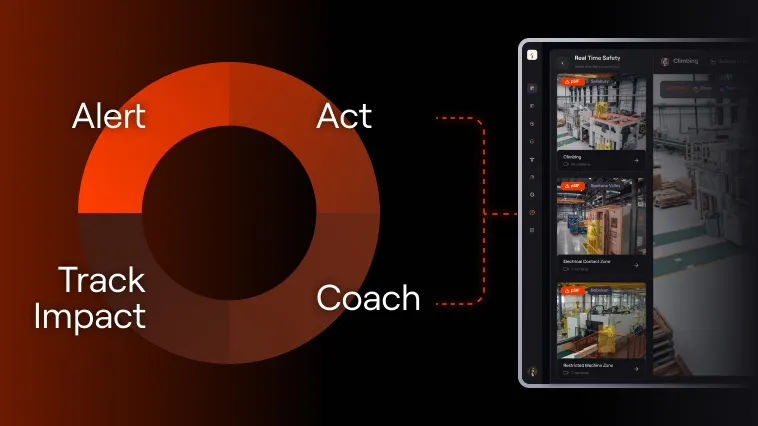


There is no shortage of safety data in enterprise manufacturing and industrial operations.
Alerts from computer vision systems. Incident reports in legacy EHS platforms. Corrective action logs. Audit findings in spreadsheets. Ergonomics assessments conducted quarterly. Near miss reports that may or may not have been filed. Worker comp claims. Inspection records. Dashboard exports that someone creates manually before every leadership review.
The data exists. The problem is that it lives in fragments — across systems, across teams, and across formats that don't connect to each other.
A safety alert that fires at 7am in an Ohio facility does not automatically become a corrective action with an owner and a deadline. An ergonomics pattern that's been building for six weeks in a specific camera zone doesn't automatically surface in an EHS director's weekly review. A near miss in one facility that has parallels to an incident in another doesn't get connected unless someone manually builds that connection.
This fragmentation is not a failure of effort. It's a structural feature of how most safety programs were built — as a collection of specialized tools and processes, each doing one job, rarely speaking to each other.
The gap between seeing and acting
What fragmentation creates, in practice, is a consistent lag between what safety teams can detect and what they can act on.
The seeing side of the equation has improved dramatically over the past decade. Computer vision covers more of the facility floor than any audit schedule could. Alert volumes have gone up. Data collection has expanded. But the acting side of safety management — the corrective action, the coaching, the executive reporting, the program improvement over time — still depends on manual coordination that can't keep pace with what the detection layer is producing.
The result is predictable: EHS managers spend significant time on administrative work that doesn't require their judgment — chasing down corrective action status, building reports by hand, translating alerts into documentation in separate systems — when their time would be better spent on the decisions that actually require their expertise.
What connected safety infrastructure changes
Connecting the detection layer to the action layer isn't a matter of adding another tool. It requires the fragmented data sources to be unified in a single operational view that supports the full workflow: from alert to corrective action to coaching to executive reporting.
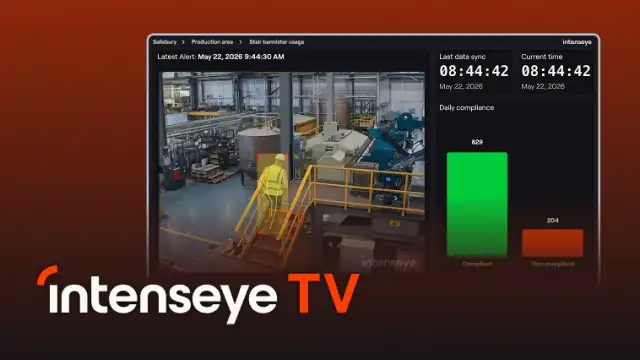
Intenseye's Console Dashboard is built around this principle. Real-time alerts connect directly to task creation. Tasks carry the original video context, severity assessment, assigned owner, and timeline — without manual transcription. The Chief AI agent threads through the entire platform as a live analyst, capable of synthesizing performance data across facilities, generating coaching materials, and preparing executive summaries on demand.
The Insights module delivers AI-generated Safety Score reporting and scheduled executive summaries — so EHS leaders stop spending time on report preparation and spend more time on the decisions those reports are supposed to support.
Beyond that, the platform connects to existing EHS systems. Corrective actions can be created and transferred automatically. Data flows to existing workflows rather than creating a parallel process that teams have to maintain separately.
What this means for program maturity
The most important thing about connected safety infrastructure is not what it does in the first 30 days. It's what it builds over time.
Every corrective action creates a data point about what worked. Every coaching session gets documented. Every intervention that reduces risk in a specific zone becomes part of an organizational record that informs how the program responds to similar risks in the future.
Safety programs that operate on fragmented data stay reactive. Programs that operate on connected data get progressively better at anticipating and preventing the risks that matter most. The difference, compounded over two or three years, is significant.
The data is already there. The question is whether it's connected in a way that lets your team act on it.
See how the Console Dashboard connects safety signals to action →