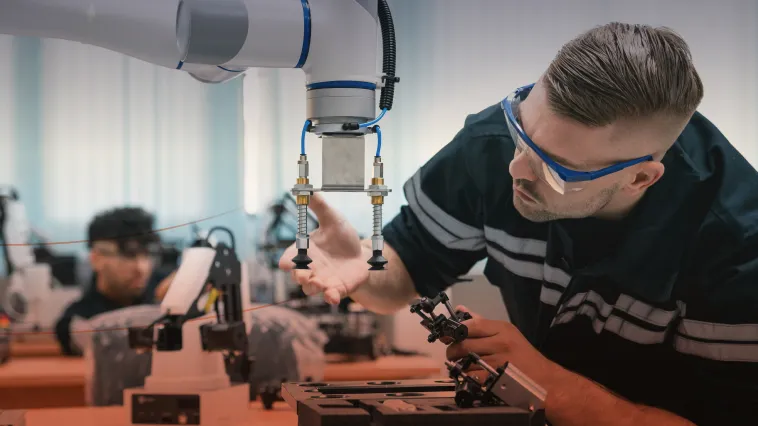

The Future of Human–Machine Collaboration Starts With Safety
EHS and manufacturing leaders know this better than anyone: the way your people work with machines today will shape your safety record tomorrow.
I recently joined the World Economic Forum to support their upcoming Global Framework on Human–Machine Collaboration, drawing from what we learn every day on real shop floors with Intenseye customers. The conversations confirmed something we see across industries. When you stay close to operations, one thing stands out.
Safety is not a department. It is the foundation every other function stands on.
Below are the core ideas I shared with the WEF team and why they matter as factories move toward more advanced forms of human–machine collaboration.
1. Human–machine collaboration starts with trust
Factories are adopting vision systems, robotics, and autonomous equipment at high speed. But none of this technology delivers its full value if frontline teams do not trust it or if leaders bypass the very rules meant to protect people.
Most failures that get labeled “human error” are actually signals pointing to deeper issues. Workflows that do not match reality. Targets that push people into unsafe shortcuts. Tools that were not built with the worker in mind.
Human–machine collaboration succeeds only when people trust the environment they operate in and the tools that support them.
2. Behavior is the real frontier of safety innovation
A light curtain can stop a machine. It cannot stop someone from walking around it.
For decades, safety systems have focused on equipment states, not human behavior. Today, technology finally allows us to understand how people move, why they take certain paths, and where systems unintentionally invite risk.
This shift from reactive inspection to real-time, behavior-aware safety is what will define the next era of industrial operations. It gives organizations the ability to redesign work so safer actions happen naturally and risky ones get engineered out.
3. New safety roles are already emerging
As AI becomes embedded in day-to-day operations, new safety-critical roles are taking shape. These roles bridge technology, human behavior, and operational reality.
EHS AI Specialist. Tunes and validates AI models, and helps teams use safety insights in the right way.
Safety Agent Supervisor. Guides how real-time signals turn into action, ensuring consistent responses across shifts and sites.
Human–Machine Workflow Designer. Designs tasks, zones, and handoffs so people and machines interact safely and predictably.
These roles already exist inside some of our customer environments. Preparing people for them is one of the biggest workforce opportunities of the decade.
4. Automation should remove exposure, not people
A major shift is underway. Instead of telling workers to “try again” on hazardous steps, organizations are redesigning those steps so the machine absorbs the risk and the worker stays clear of harm.
The goal is not headcount reduction.
The goal is exposure reduction.
Automation becomes a tool for safer collaboration, allowing people to focus on oversight, problem solving, and the judgment that machines rely on.
5. Safety needs a real seat at the strategy table
Safety data is no longer a compliance artifact. It is one of the most accurate views of how work actually runs, especially as people and machines become more interconnected.
When leaders treat safety data as a strategic input, safety teams help shape how systems work, and frontline workers can interact with technology as partners, not rule followers trying to compensate for broken processes.
This is essential for true human–machine collaboration. Without it, technology and people end up working against each other instead of together.
Where this work is heading
The WEF team is now building a global framework around these questions, reflecting challenges that EHS and operations leaders face every day. This work brings together the World Economic Forum’s Frontline Talent of the Future and The Next Frontier of Operations initiatives and will launch in 2026 to help guide how human–machine collaboration evolves worldwide.
There is no future of work without the future of safety.
If you are rethinking how your people and machines will work together over the next three to five years, I am always open to compare notes.
Learn more:
Frontline Talent of the Future
The Next Frontier of Operations