

Traditional workplace safety monitoring answers a simple question: did something unsafe just happen? That's valuable — but it's not enough. The harder question, the one that actually changes how safety teams prioritize and respond, is: how serious could this have been, and why?
Today, we're introducing a new capability inside the Intenseye platform that helps answer exactly that. We've integrated NVIDIA Cosmos Reason 2 — a state-of-the-art reasoning vision language model — directly into the Intenseye control room, giving safety teams on-demand access to deep, AI-powered video analysis at the point of decision.
From Detection to Understanding
Intenseye already monitors industrial facilities in real time, using computer vision to detect unsafe conditions and alert safety teams within seconds. That detection layer isn't going anywhere — it's the foundation.
What NVIDIA Cosmos Reason 2 adds is a reasoning layer. Instead of simply flagging that a hazard exists, the model watches the full video sequence and interprets what's actually happening in the scene: how workers are moving, what equipment is in play, how the environment contributes to risk, and how those factors interact.
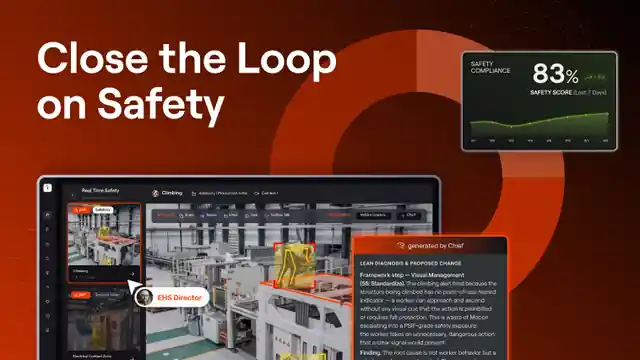
The result is a structured risk intelligence report generated in seconds — not a generic summary, but a detailed breakdown that includes identified hazards with quantified risk scores, the specific evidence the model observed in the footage, and a prediction of how likely the event was to result in a serious injury or fatality.
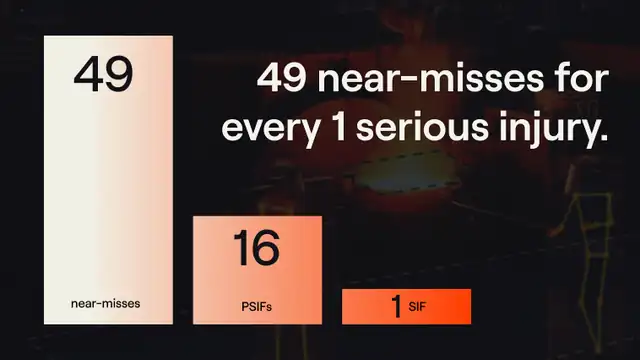
That last piece — the pSIF (potential Serious Injury or Fatality) prediction — is what shifts this from interesting to indispensable. It gives safety leaders a concrete, data-backed way to distinguish a close call from a near-catastrophe, and to allocate their attention accordingly.
One Click, No Context Switching
We were deliberate about how this integration lives inside the platform. When an operator is reviewing a safety alert in the Intenseye control room, a Cosmos button appears right alongside the video. One click sends the footage to NVIDIA Cosmos Reason 2 for analysis. A few seconds later, the results appear in a clean, structured panel — overlaid directly on the alert view.
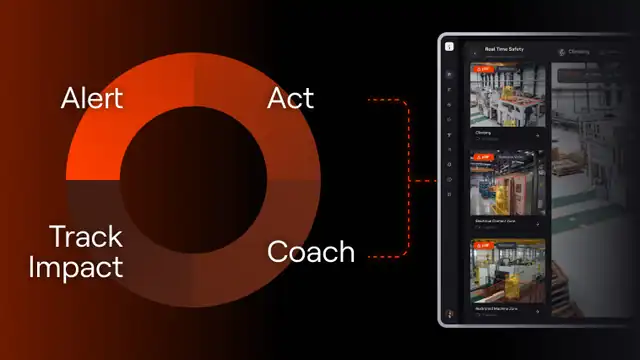
There's no separate tool to open. No data to export. No workflow to interrupt. The operator reviews the findings, understands the risk, and moves straight into action — assigning corrective tasks, escalating to leadership, or documenting the event — all within the same interface they already use every day.
This matters because the biggest bottleneck in safety operations isn't the technology. It's the time between seeing a problem and doing something about it. Every extra step, every context switch, every manual review adds delay. This integration compresses that gap.
What the Model Actually Sees
It's worth pausing on what makes NVIDIA Cosmos Reason 2 different from a standard computer vision model. Most safety AI systems are trained to recognize specific patterns — someone without a hard hat, a forklift in a pedestrian zone, a blocked emergency exit. They're effective at catching known violations.
Cosmos Reason 2 operates at a different level. Built on NVIDIA physical AI foundation, it reasons about the scene the way a trained safety professional would: considering spatial relationships, temporal sequences, physical dynamics, and contextual factors that a rule-based system would miss. It doesn't just see that a worker is near a moving vehicle — it evaluates the trajectory, the proximity, the line of sight, and the likelihood of a collision.
This is the difference between a system that tells you what happened and one that helps you understand why it's dangerous.
Built for Scale
The integration runs on NVIDIA DeepStream, which powers high-throughput video processing across large industrial deployments. Whether a company operates five facilities or five hundred, the architecture is designed to handle the volume — processing video at the edge and delivering results back to the control room without bottlenecks.
For global operations with multilingual teams, Cosmos Reason 2 also supports natural-language explanations in over 100 languages, making the insights accessible to safety personnel regardless of location.
A New Standard for Proactive Safety
The workplace safety industry has spent decades building reactive systems — incident reports filed after the fact, investigations triggered by injuries, compliance checklists reviewed on a schedule. The shift to real-time detection was a major step forward. This integration represents the next one.
With Intenseye and NVIDIA Cosmos Reason 2, safety teams don't just see hazards faster. They understand them more deeply, quantify their severity with precision, and act on them before outcomes escalate. It's the difference between monitoring a workplace and truly protecting the people inside it.
The NVIDIA Cosmos Reason 2 integration is available now within the Intenseye platform. To see it in action, request a demo.